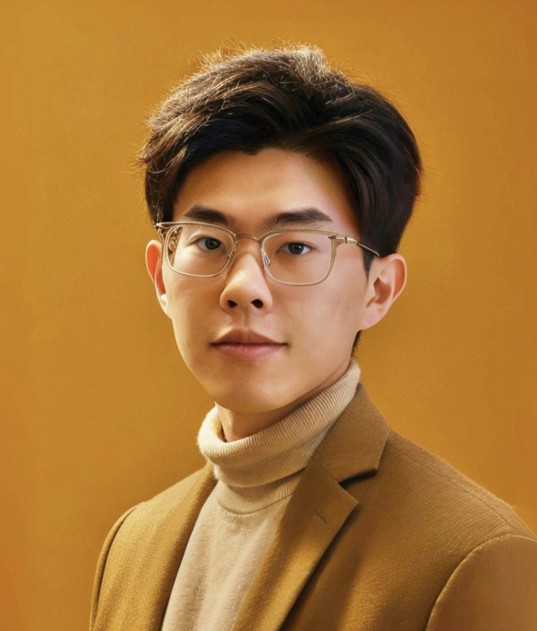
Junyao He is an urban researcher, computational social scientist, and economic geographer. His research uses complex networks, spatial econometrics, agent-based modeling, and GeoAI to study how digitalisation and AI reshape urban and regional system, covering human mobility, labour markets, and migration. He is particularly interested in the social inequalities, demographic heterogeneity, and social sustainability in these transitions.
His work connects four empirical fields: urban studies; mobility and migration; economic geography; and computational social science. His methodological work is mix-methods. He works with on-site evidence from interviews and workshops. He is also the expert in complex network analysis, spatial econometrics, causal inference, agent-based modelling, interpretable machine learning, and large-scale text analysis.
Junyao He completed a PhD in Human Geography and Spatial Planning at Utrecht University. He holds an MSc in Urban Design and International Planning from the University of Manchester and a BSc in Human Geography and Urban and Rural Planning from Southwest University. Junyao has accumulated nearly four years of experience in the consulting industry and has led large-scale consulting projects for both the public and private sectors, primarily related to urban analytics and urban policy.
Current research
Junyao He’s current research is organised around two connected programmes:
- Remote work and spatial reconfiguration: Remote and hybrid work alter job home networks, residential relocation, labour market reach, housing pressures, and uneven regional development. See Research, the Netherlands job home network research and the Spain hybrid-work network research.
- Mobility networks and regional inequality: Migration, relocation, and digitally enabled mobility connect cities and regions while redistributing opportunity. This includes digital nomad mobility and individual trajectories and heterogeneous Dutch migration networks.
An established research line examines digital planning, platform governance, and networked power, extending his doctoral work on social media participation and inequalities in collaborative planning. An emerging direction focuses AI, innovation, and regional networks through large scale news text and graph based methods.
See the Research page for fuller descriptions, Projects for principal doctoral and postdoctoral projects, Publications for published work, Working Papers for current manuscripts, Activities for editorial service, academic service, blogs, talks, and conferences, and Teaching for courses and supervision.
Recent highlights
- Guest Co-Editor for the 2027 Society Register Special Issue, Participatory Urban Governance Beyond Western Democracies: Motivations, Expressions, and Outcomes.
- Journal article (2026): Different Strokes for Different Folks: Remote Work, Heterogeneity, and Restructuring of Relocation Networks in the Netherlands
- Journal article (2026): Does Hybrid Work Decentralize Labor Markets? Evidence from Spain’s Job-Home Networks
- Journal article (2026): Urban greening and public safety across day and night: A street-view and AI-based assessment of spatial safety context
- Revised & Resubmitted: Teleworkability and the Evolution of Job-Home Networks after the COVID-19 Shock: Causal Evidence from the Netherlands
- Finalizing manuscript: Moving, Staying, Returning: Global Mobility Networks and Individual Trajectories of Digital Nomads
- Finalizing manuscript (Abstract accepted): Measuring Global AI Cooperation, Competition and Innovation through News Text: A Graph-based Approach
- Report (2026): MOBI-TWIN D3.4: The Effects of Spatial Mobility during Twin Transition on Regional Inequality and Sustainability in the Identified EU Regional Typologies
- PhD thesis (2026): Network Power and Social Media: Reshaping Power Dynamics in Collaborative Planning in China.
- Journal article (2026): Social Media Influence on Collaborative Planning: Framing Strategies in Online Public Participation.
- Journal article (2024): Informal participation in digital planning: How can third parties use social media to shift power relations in planning?.
- Journal article (2024): Measuring social network influence on power relations in collaborative planning: A case study of Beijing City, China.
Contact
Department of Economic Geography, University of Groningen
Email: J.HE@RUG.NL
Google Scholar · ORCID · LinkedIn
Junyao is also a passionate landscape and astrophotographer. His photography documents natural and urban landscapes, night skies, and the Milky Way. Selected work is available on Instagram and Xiaohongshu.